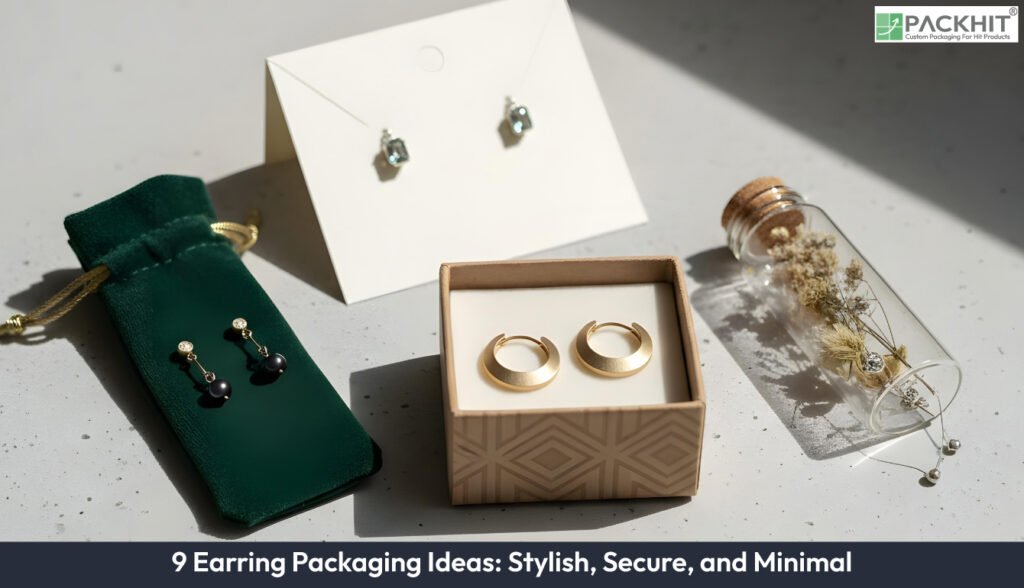
The nine earring packaging ideas include magnetic closure boxes, rigid drawer boxes, hinged lid boxes, two-piece boxes, shoulder neck boxes, origami style packaging, kraft jewellery cards, velvet pouches and seed paper cards. Magnetic-closure boxes, rigid drawer boxes, and hinged-lid boxes prioritise controlled presentation through precise opening mechanics, whether via concealed magnets, regulated slide motion, or fixed-angle hinges that stabilise single-pair displays. Two-piece boxes and shoulder-neck boxes shift focus toward structural containment, using friction-fit lids and internal collars to prevent over-closure, distribute compression, and protect delicate posts or gemstones during stacking and storage. Folding origami boxes reduce construction to a single folded sheet, eliminating adhesives while maintaining tension-based stability. Kraft jewellery cards simplify mounting and identification into one rigid, low-print surface that prevents tangling. Velvet pouches replace rigid walls with tensile drawstring closure, reducing shipping volume while limiting abrasion. Seed paper cards extend minimalism further by combining alignment, display, and post-use biodegradability within one uncoated fibre format.
1. Magnetic Closure Boxes
Magnetic-closure boxes embed paired magnets within folded board flaps, producing a silent, repeatable closure. The concealed mechanism avoids visible hardware while maintaining consistent alignment after repeated openings. This construction suits higher-value earrings where controlled access and precise lid registration matter more than material softness.
2. Rigid Drawer Boxes
Rigid drawer boxes separate the outer sleeve from the inner tray, creating a linear reveal motion. Friction between the sleeve and tray regulates opening speed, preventing sudden exposure. The tray often includes a die-cut foam or board insert sized precisely to the earring form. Exterior surfaces typically remain matte and uncoated, reinforcing a minimal aesthetic while preserving structural stiffness.
3. Hinged-Lid Boxes
Red velvet hinged boxes combine a rigid shell with a mechanical hinge that opens to a predefined angle, usually between 85 and 95 degrees. The interior flocked surface increases friction, limiting micro-shifts during handling. Velvet absorbs minor shock but remains compact, which suits single-pair presentation rather than batch storage. The saturated red colour acts as a visual anchor while the exterior typically remains free of surface graphics.
4. Two-piece Boxes
Two-piece boxes consist of an independent lid and a rigid base, forming a friction-fit enclosure around a fixed cavity insert. The structure distributes compressive force across the box walls rather than the jewellery itself, which reduces post deformation during stacking. Minimal branding, often limited to blind debossing or monochrome foil, preserves visual restraint while maintaining recognition. Typical dimensions range between 55–70 mm square, allowing secure placement of studs, huggies, or small drops without lateral movement.
5. Shoulder-Neck Boxes
Shoulder-neck boxes introduce an internal collar that locks the lid at a fixed depth. That collar prevents over-closure and stabilises earrings mounted on pads or cards. The visible shoulder line becomes a design element, often left unprinted to emphasise material contrast. This format supports lightweight metals and gemstone studs where vertical clearance must remain consistent to avoid pressure on posts.
6. Folding Origami Box
Origami-style boxes use one flat sheet that folds into a box for holding earrings, keeping packaging minimal and low waste. The sheet folds into a self-locking shape. Creases and slots hold the structure in place without glue, magnets, or metal parts. Earrings rest on folded inner flaps or slotted cards, which keep stud spacing and hook direction fixed. Kraft or plain board, usually 300–350 gsm, stays matte and uncoated. Sheets ship flat and fold during packing, which reduces material use, storage space, and visual clutter.
7. Kraft Jewellery Cards
Kraft jewellery cards combine product mounting and identification in one flat format. Pre-punched holes hold posts or hooks in fixed spacing, reducing rotation and tangling. Cardstock between 300 and 350 gsm maintains stiffness without lamination. Branding remains limited to small logotypes, metal purity marks, or batch codes.
8. Velvet Pouches
Velvet pouches rely on tensile closure rather than rigid walls. Drawstrings compress the fabric evenly, holding earrings against the surface without a point load on posts or hooks. Shipping volume stays low because the pouch collapses flat, which suits mailer-based distribution. Visual restraint comes from single-colour textiles and unprinted exteriors, usually under 90 mm in height.
9. Seed Paper Cards
Seed paper cards act as both a mounting surface and a disposable package. Earrings pass through pre-cut slots, keeping alignment fixed during display and transit. After use, the card decomposes in soil and germinates, which removes packaging waste from the lifecycle. The uncoated fibre texture and muted tones support minimal packaging for earrings without added inks or finishes.