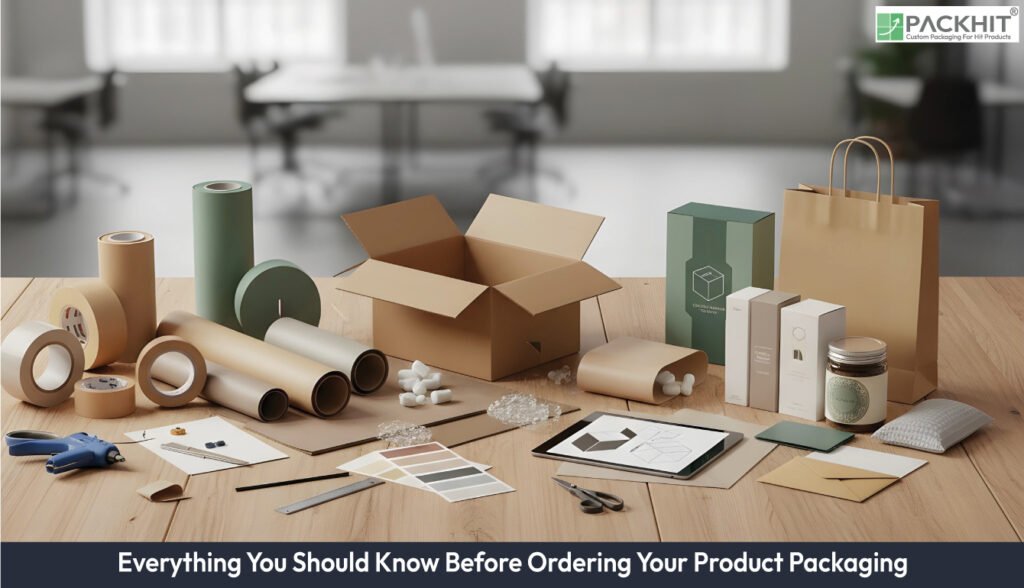
Packaging is a controlled system of materials, structure, print, and labelling that protects a product, stabilises it during storage and transport, and communicates verified information at the point of sale. Performance depends on defined specifications for material grade, box geometry, print tolerance, finishes, sustainability claims, dimensions, and handling tests, all operating within packaging‑waste regulations and commercial production chains such as mills, converters, and printers. Labelling adds fixed data such as composition, quantity, care, recycling marks, and disposal instructions. Packaging types are classified by role and format, for example primary, secondary, tertiary, e‑commerce mailers, retail cartons, shelf‑ready trays, flexible packs, rigid boxes, and compostable fibre formats. Custom packaging is built around exact product dimensions, brand identity, and logistics constraints, unlike stock packaging, which uses standard sizes with lower setup cost and limited branding. Common materials include folding board, corrugated fibreboard, moulded pulp, bioplastics, plant‑based polymers, plastics, metals, and glass. Development follows a set sequence from functional brief and concept sketches to prototypes, performance checks, tooling, and controlled production, with cost driven by material grade, design time, print setup, finishes, tooling, and freight.
- What is Packaging?
- What Defines Packaging Specifications?
- What is the History of Packaging?
- What is the Purpose of Packaging?
- What Does Labelling Cover in Packaging?
- How are Packaging types classified?
- What is Custom Packaging?
- Which Packaging Materials are Commonly Used in Product Packaging?
- Paper-Based Packaging Materials
- Sustainable Packaging Materials
- Edible Packaging Materials
- Plant-Origin Packaging Materials
- Plastic Packaging
- Metal Packaging
- Glass Packaging
- What are the Steps in the Packaging Development Process?
- 1. Define the functional brief
- 2. Create structural and print concepts
- 3. Produce and evaluate prototypes
- 4. Run performance and compliance checks
- 5. Prepare production‑ready files and tooling
- 6. Execute controlled production
- Conduct post‑run verification
- Document final specifications for repeat runs
- What are the Different Roles Carried out in Packaging Production?
- How Much Does Packaging Cost?
- How Does Packaging Affect Product Marketing?
- Why is Packaging Design Critical for Product Performance?
- What Does a Packaging Designer Do?
- How Does a Packaging Engineer Produce Structural Packaging?
- Which Types of Suppliers Provide Product Packaging?
- How to Order Custom Packaging for Your Products?
- 1. Understand your packaging needs
- 2. Estimate your packaging budget
- 3. Select the packaging type
- 4. Measure box dimensions for product packaging
- 5. Choose the right material for your product packaging
- 6. Look for sustainable packaging materials
- 7. Select the box style for your product packaging
- 8. Create the design of the packaging
- 9. Choose the appropriate printing option for your product packaging
- 10. Select the add‑ons and finishes
- 11. Find a trusted packaging supplier
- Why Request Samples and Prototypes?
- Which Finishes and Post‑print Processes Affect Cost and Attention?
- What End-of-Life Packaging Options fit Sustainable Waste Routes?
What is Packaging?
Packaging is the engineered combination of materials, structure, surface treatment, and printed information that encloses a product and controls its protection, identification, transport, and presentation. Packaging begins at the point of manufacture and ends at disposal or reuse, and its form changes with channel, product weight, and handling frequency.
In physical terms, packaging consists of four fixed components: a substrate (paperboard, corrugated fibreboard, plastic, metal, or glass), a structural format (box, bag, mailer, sleeve), a surface system (coating, laminate, varnish, or raw fibre), and a communication layer (print, labels, symbols). Each component carries measurable limits such as grammage, compression strength, tear resistance, ink adhesion, and fold tolerance.
In retail and fashion sectors, packaging often appears as folding cartons, rigid set‑up boxes, paper shopping bags with handles, garment mailers, or branded shipping boxes. Clothing boxes protect folded garments from compression and abrasion. Luxury handbag packaging uses rigid board, wrapped papers, and reinforced corners to resist edge crush and scuffing during handling. Paper mailer packaging controls parcel thickness and tear resistance for e‑commerce clothing shipments.
What Defines Packaging Specifications?
Packaging specifications set measurable limits for material grade, structure, print behaviour and finish durability. These limits guide how a pack performs in storage, transit and retail handling.
- Material grade sets stiffness and tear strength for paper mailers, folding cartons or corrugated cases (examples: 300–400 gsm folding board, single‑wall corrugated with B‑flute). Apparel brands use kraft board or rigid board for clothing boxes and handbag packs if the weight and scuff risk increase.
- Structural geometry fixes closure type, reinforcement points and handle load (examples: rope‑handle shopping bags, rigid set‑up boxes, reverse‑tuck clothing cartons). Luxury clothing packaging uses tighter tolerances than standard retail cartons, if uncoated paper wraps appear on lids or bases.
- Print behaviour states ink set, colour consistency and readable type size. Fashion packaging often carries condensed sans‑serif fonts, monochrome palettes and high‑contrast logo zones to maintain legibility on bags, gift boxes and mailers.
- Surface finishes define foil weight, emboss depth and varnish type. Luxury handbag boxes and clothing gift boxes use foil stamping or blind emboss patterns if brand identity depends on raised logos or metallic accents.
- Sustainability qualifiers confirm recyclability, compostability or reusability (examples: mono‑paper mailers, uncoated kraft cartons, reusable rigid boxes). Clothing brands specify water‑based inks and animal‑free adhesives if vegan compliance forms part of label policy.
- Dimensional tolerance keeps lids, bases and inserts aligned. T‑shirt boxes, shoe boxes and luxury gift sets require tight variation limits so printed patterns and edges align during assembly.
- Handling performance covers bag handle load tests, edge‑crush for corrugated cases and scuff resistance for wrapped rigid boxes. Shopping bags and garment boxes often include rub‑test data, if uncoated papers mark during transport.
These constraints apply across apparel, accessories and e‑commerce clothing shipments, and they combine to create specifications that match protection targets, branding direction and available retail or household recycling routes.
What is the History of Packaging?
The history of packaging traces a progression from natural containment methods to engineered materials that control preservation, transport and communication demands. Early humans relied on unprocessed carriers such as leaves, gourds and woven fibres for short-distance movement of food and tools. Archaeological records add ceramic pots, sealed jars and later blown‑glass vessels for liquids and fragile goods. These forms introduced impermeability and basic closure systems. Paperboard reshaped packaging in 1817 when the first carton was produced in England; folding cartons appeared in 1860 and were shipped flat to reduce space during transport. Corrugated structures emerged later in the nineteenth century and created rigid, crush‑resistant formats for industrial movement. Glass containers followed their own track: furnace improvements enabled thicker walls and repeatable shapes, which expanded use in food and chemical distribution. Each stage shows a shift driven by storage life, transport distance and production method. Packaging history links material invention, forming accuracy and distribution scale.
What is the Purpose of Packaging?
The purpose of packaging is to control product condition, communicate verified information, and maintain physical integrity through storage, handling, sale, and disposal. Packaging performs four technical functions that operate in parallel rather than sequence.
- Protection limits damage from compression, vibration, abrasion, and moisture, with examples such as corrugated shipping boxes, rigid setup boxes for luxury clothing, and paper mailers with tear resistance.
- Preservation maintains product state over time by restricting air, light, or contamination, with examples including sealed folding cartons, lined garment boxes, and wrapped handbag packaging.
- Identification communicates brand, product, and regulatory data at fixed positions, with examples such as size labels on clothing boxes, care symbols, fibre composition panels, and recycling marks.
- Distribution support stabilises products during stacking, palletising, and last‑mile delivery, with examples including flat‑packed cartons, reinforced shopping bags with handles, and dimension‑matched e‑commerce mailers.
In retail and fashion sectors, packaging also controls presentation during unboxing and display. Luxury clothing boxes, branded shopping bags, and paper garment mailers manage first contact by defining opening sequence, logo placement, and surface texture. These elements guide handling behaviour, reduce return damage, and preserve brand consistency across physical stores and online fulfilment.
What Does Labelling Cover in Packaging?
Labelling in packaging communicates regulatory, compositional and brand information directly on the pack.Labels list composition, quantity, storage instructions and disposal guidance, if disposal rules apply. National schemes such as OPRL (On-Pack Recycling Label) set wording for recycling status, so labels follow fixed phrases and icons. Clear type, simple hierarchy and distinct pictograms raise legibility. Low legibility reduces user understanding and slows correct sorting. Consistent placement across packs keeps information predictable and reduces misreading during quick checks.
How are Packaging types classified?
Packaging types are classified based on purpose, functionality, and material that are selected for containment, protection, or display in packaging. Each type occupies a point in production, storage, or retail movement and uses defined substrates such as paperboard, plastics, or metal.
The different types of packaging are given below:
- Primary packaging holds the product in direct contact zones and controls contamination with fixed labels and measured closures.
- Secondary packaging groups primary units in corrugated sleeves or chipboard cartons to stabilise storage and guide retail restocks.
- Tertiary packaging supports pallet transport through stacked corrugated cases or stretch‑wrapped loads that resist crush and vibration.
- E‑commerce packaging protects parcels in last‑mile cycles using mailer boxes or padded envelopes that reduce shift during handling.
- Retail packaging positions printed panels for quick scans in aisles through rigid cartons or hanging cards that keep UPC zones steady.
- Shelf‑ready packaging moves perforated trays or tear‑away shippers from pallet to shelf in one action while keeping rows aligned.
- Frustration‑free packaging removes excess layers and uses right‑sized mailers with peel seams that cut waste and simplify opening.
- Flexible packaging forms pouches or laminates that fold easily and keep oxygen and moisture at controlled levels for powders or liquids.
- Rigid packaging uses glass, metal or moulded plastic to hold shape and resist compression during stacked warehouse cycles.
- Sustainable packaging applies mono‑material or recycled substrates such as kraft board or moulded fibre trays that support municipal recovery.
- Compostable packaging uses fibres, starch blends or PLA films that decompose under controlled industrial composting conditions.
What is Custom Packaging?
Custom packaging involves applying a bespoke physical design and printed artwork to suit a particular product, brand and logistics profile. Custom work requires specification of dielines, structural reinforcements and print files, and typically includes a prototype run so manufacturers, designers and quality teams can verify fit, artwork registration and functionality prior to full production.
How Does Custom Packaging Differ from Stock (pre‑made) Packaging?
Custom packaging differs from stock packaging because it is engineered for product fit, protection and brand presentation, while stock packaging prioritises immediate availability and lower initial cost bands. Custom work adapts geometry, inserts and print placement around exact product measurements. Custom packaging accepts unique geometry, printed artwork and specialised finishes at the expense of higher setup time and per‑unit cost for small runs, whereas stock packaging is pre‑manufactured in standard dimensions and is immediately available with a lower unit price but limited branding and fit.
Which Packaging Materials are Commonly Used in Product Packaging?
Commonly used packaging materials include paper‑based substrates such as folding board and corrugated fibreboard, rigid materials such as glass and metals, flexible and rigid plastics, and sustainable alternatives such as moulded pulp and plant‑based biopolymers, selected according to product weight, barrier needs, handling frequency, and disposal route.
Paper-Based Packaging Materials
Paper-based packaging uses fibre substrates for predictable folding, stacking strength, and print clarity.
- Kraft paper: tear resistance for bags and wraps.
- Cardboard: lightweight sheet for simple cartons.
- Corrugated fibreboard: fluted core for transit protection.
- Rigid board: dense board for luxury boxes.
- Paperboard: smooth surface for folding cartons.
- Chipboard: recycled layers for backing cards.
- Cardstock: high‑GSM sheets for inserts and tags.
- Buxboard: recycled board for economical retail boxes.
Sustainable Packaging Materials
Sustainable materials reduce waste through compostability or renewable inputs.
- Moulded pulp: recycled fibre trays and inserts.
- Mushroom packaging: mycelium structures for shock absorption.
- Bioplastics: plant‑derived polymers for flexible packs.
Edible Packaging Materials
Edible materials combine containment and consumption for food applications.
- Seaweed films: dissolvable sachets.
- Rice paper: thin wraps for confectionery.
- Gelatin films: water‑soluble portion packs.
Plant-Origin Packaging Materials
Plant-origin materials convert agricultural waste into compostable structures.
- Cornstarch material: compostable trays and bags.
- Bagasse: sugarcane fibre plates and containers.
- Bamboo fibre: rigid moulded packs.
Plastic Packaging
Plastic packaging controls moisture, weight, and tear resistance. Common resins include polyethene, polypropylene, and PET, used in pouches, mailers, bottles, and rigid containers.
Metal Packaging
Metal packaging maintains barrier strength and recyclability. Aluminium and steel appear in cans, tins, and industrial containers.
Glass Packaging
Glass packaging preserves product stability and flavour. Typical uses include beverage bottles, cosmetic jars, and pharmaceutical containers.
What are the Steps in the Packaging Development Process?
The steps in the packaging development process set the sequence from functional brief to controlled production by defining product geometry, sketching structure and print concepts, producing prototypes, checking performance and compliance, preparing tooling, and verifying bulk output.
1. Define the functional brief
The packaging development process starts with a functional brief that states product geometry, mass, fragility and distribution conditions. This brief anchors the technical scope and sets constraints for material grade, print method and structural limits. Teams record shelf-life targets, transit hazards and storage humidity ranges. Clear parameters restrict unnecessary redesign and frame the sequence that follows.
2. Create structural and print concepts
Concept creation produces initial structural layouts and print arrangements. Designers sketch panel hierarchies, colour fields and regulatory zones; engineers mark load points and closure paths. Early sketches allow quick elimination of unsuitable structures. Short digital mockups test proportion, alignment and readability on different substrates.
3. Produce and evaluate prototypes
Prototype production converts the draft dieline into a testable sample. Samples confirm fit, crease behaviour, ink holdout and tolerance drift over repeated folds. Teams record dimensional change and panel rigidity after compression, if the pack enters multi‑handling cycles. The sample stage removes structural faults before tooling is cut.
4. Run performance and compliance checks
Performance checks assess crush strength, seam security and labelling clarity. Drop tests, edge‑crush ratings and print rub checks expose weak points. Regulatory panels are reviewed for mandatory content and placement. These checks prevent rework at production scale and keep the design within accepted material recovery codes.
5. Prepare production‑ready files and tooling
Production preparation finalises dielines, print plates and cutting forms. Artwork files lock typography, image boundaries and colour targets. Engineers mark bleed, trim and fold points so converters can set tooling without guesswork. Accurate preparation reduces setup errors and waste during first runs.
6. Execute controlled production
Controlled production applies print, cut and fold operations under defined QC criteria. Operators track colour deviation, crease location and adhesive spread. QC teams compare samples against signed references. This stage captures mechanical drift and prevents units with misaligned panels or inconsistent print density from entering the supply chain.
Conduct post‑run verification
Post‑run verification inspects bulk output for dimensional variation and finish durability. Random sampling checks fibre tear, varnish resistance and closure reliability. Reports record pass rates and deviation bands. Verification data supports repeat orders with minimal recalibration.
Document final specifications for repeat runs
Final specification documents lock material codes, grammage values, tolerance ranges and print conditions. This record enables predictable repeat orders and fixed‑cost procurement. Documentation also shortens lead time for future adjustments if a supplier needs updated operational data.
What are the Different Roles Carried out in Packaging Production?
Packaging production assigns distinct technical tasks to designers, structural engineers and manufacturers. Designers set artwork hierarchy, colour boundaries and finish zones as they specify ink families, foil temperatures and varnish types, if special surfaces appear in the brief. Structural engineers analyse substrate grade, crease behaviour and closure geometry as they test load points, confirm fold paths and adjust dielines when material density changes. Manufacturers run print, cut and fold cycles under QC limits. They record colour shift, adhesive spread and panel alignment during bulk runs and document pass rates from random samples. Teams confirm adhesive composition, if the pack must exclude animal‑derived glues.
How Much Does Packaging Cost?
Packaging cost ranges from about £0.40 to £0.80 per unit for common paper‑based formats in small or medium runs. These values shift with material grade, print method and structural complexity. Simple one‑piece cartons sit near the lower band, and multi‑panel constructions with tighter tolerances move toward the upper band.
Cost forms through six components: material grade, design hours, print setup, finish application, tooling and freight. Material grade affects fibre density and weight. Design hours cover dieline adjustments and artwork checks. Print setup introduces plate or machine calibration charges if multi‑colour work appears. Finish application includes varnish, foil or emboss dies. Tooling covers cutting formes and crease rule preparation. Freight reflects pallet count and flat‑pack density.
Unit cost drops as order quantity increases because setup work spreads across more units. Small runs hold higher per‑unit rates, if print plates or cutting formes require one‑off preparation. Flat‑packed formats reduce transport weight and lower final cost, if pallet fill reaches stable ratios.
How Does Packaging Affect Product Marketing?
Packaging influences consumer behaviour by governing shelf presence and first‑impression impact. A well‑executed pack increases the probability of selection at the point of sale through visual contrast and a clear information hierarchy. Typography choices and surface finishes align the physical object with brand positioning; typography and layout shape perception of product quality and trustworthiness. According to the University of Portsmouth (School of Marketing, 2022), controlled shelf‑test data showed a 28% rise in first‑choice selection when packaging displayed clear typographic hierarchy and consistent brand markers such as logo weight, colour field and finish uniformity.
How Does Packaging Increase Brand Awareness?
Packaging carries brand signifiers such as logo, colour, typographic system and tactile cues that increase recognition across repeat purchases. Consistent application of these signifiers on primary and secondary packs multiplies exposure across retail environments and during unboxing, supporting memorability and repeat purchase behaviour. According to the University of Leeds (School of Design, 2021), repeated exposure to the same colour field and logo weight increased brand recall by 32% during controlled packaging recognition tests, and tactile consistency across substrates increased correct brand identification by 18% during blind-handling trials.
Why is Packaging Design Critical for Product Performance?
Packaging design is critical because structural, regulatory and environmental limits must align with clear printed communication to maintain product performance. Short, direct text, stable colour fields and consistent layout raise readability. Weak layout, small type or unclear label order reduces shelf clarity. Poor crease paths, weak closure points or low‑grade substrates increase scuff, dent risk or seam failure during courier handling. Clear print zones support fast recognition and reduce return rates if buyers check information quickly. Strong front‑panel hierarchy reduces confusion in retail aisles and stabilises conversion. Controlled structure and readable print keep packs intact and understandable from dispatch to unboxing.
What Does a Packaging Designer Do?
A packaging designer specifies artwork, selects print processes and recommends finishes. Designers define artwork files and produce dielines for approval. They assess regulatory labelling needs, recyclability claims and recommend material families (examples: coated board, uncoated kraft, barrier laminates) consistent with sustainability targets and brand requirements.
How Does a Packaging Engineer Produce Structural Packaging?
A packaging engineer converts design intent into manufacturable structures by selecting material grade, calculating box strength and advising reinforcement points and closure systems. Typical engineering tasks include compressive load assessment for pallet stacks, drop testing criteria definition, and advice on flute grade and grammage for corrugated cases.
Which Types of Suppliers Provide Product Packaging?
Packaging supply chains include folding carton converters, corrugated box mills, digital and lithographic printers, and finishing houses (examples: local converters for short runs, larger mills for high‑volume corrugated). Specialist vendors supply luxury finishing (for example, foil stamping specialists) and prototype houses provide single or small‑batch samples for design verification.
How to Order Custom Packaging for Your Products?
To order custom packaging, map product dimensions and handling risks, compare material grades, select a structural style that fits transport limits, confirm recyclability statements, prepare artwork, and test prototypes so suppliers can cut tooling and run stable production.
1. Understand your packaging needs
Define clear packaging needs through measured product data. Record shape, weight, fragility and exposure conditions in short, direct terms. Sort the target channel into three groups: retail shelf, e‑commerce fulfilment, or wholesale. State marketing aims with brief notes that explain colour, print or finish priorities. Add context from quick inspiration searches, for example, structural ideas, paper‑based styles or graphic trends. These inputs help you select materials and structures that support protection and presentation in controlled steps, if transit risks increase.
2. Estimate your packaging budget
Estimate your packaging budget with a clear cost band and fixed categories. Set the band first, then split it across material cost, print and finish cost, tooling and sample cost, and transport cost. Use short, direct values such as per‑unit ranges or per‑plate charges, if a supplier states them.
Order quantity changes unit cost, so compare three ranges: test runs, small runs and bulk runs. Small runs carry higher unit cost because setup charges sit on fewer units. Bulk runs reduce cost because flat‑pack density raises pallet fill.
Add a small contingency for edits. Artwork corrections, colour changes and compliance checks often require a second proof. Short revisions avoid reprints later. Use a simple sheet to track cost per item, print process choice and finish count. This sheet keeps later steps predictable and avoids drift when new ideas from inspiration boards appear in the design phase.
3. Select the packaging type
Select the packaging type by matching product use and handling conditions with three format groups. Primary packs hold the product and control contact zones (examples: tubes, sachets). Secondary packs group units for retail or storage (examples: cartons, sleeves). Tertiary packs stabilise transit loads through corrugated cases. Pick a type that meets protection and display goals and keeps pallet and warehouse dimensions consistent. Short inspiration searches from recent packaging boards support quick comparisons of shapes, openings and proportions, if visual direction guides style choice.
4. Measure box dimensions for product packaging
Record precise internal product dimensions plus clearance for inserts and protective layers. Present final dimensions as length × width × height and indicate orientation during shipment to ensure consistent dieline development.
5. Choose the right material for your product packaging
Select material family according to barrier, stiffness and printability needs (examples: mono‑paper for recyclability, coated board for high‑quality print, corrugated for transit). Confirm food‑contact compliance where applicable and avoid animal‑derived adhesives if vegan labelling is required.
6. Look for sustainable packaging materials
Prioritise recyclable, biodegradable or reusable materials where feasible. Specify recyclability claims and confirm compliance with national labelling schemes (for example, OPRL standards). Selecting flat‑pack designs and reduced pallet volumes conserves transport carbon and lowers logistics cost.
7. Select the box style for your product packaging
Pick a structural style, for example, tuck‑end carton, reverse tuck, sleeve, rigid set‑up box, corrugated case, based on product weight and retail presentation. Box style selection defines tooling needs as complex mechanical closures increase setup cost and require prototype validation.
8. Create the design of the packaging
Deliver print‑ready artwork including dieline, trim, bleed and colour indications. Specify typography, imagery and information hierarchy. Request a digital proof and a physical sample to verify print registration, colour matching and touch finishes prior to bulk production.
9. Choose the appropriate printing option for your product packaging
Select printing processes and ink systems compatible with material and sustainability goals (examples: digital for short runs, offset for longer runs). Specify special processes such as foil stamping, embossing, to achieve the required visual effects and list them in the production brief so suppliers can price accurately.
10. Select the add‑ons and finishes
Decide on functional and decorative add‑ons such as custom tissue paper, branded stickers, tamper seals and internal supports (examples: molded pulp inserts, foam cradles). For each finish, confirm lead times and minimum order quantities because they affect lead time and unit cost.
11. Find a trusted packaging supplier
Choose a supplier that matches your run size and technical needs, such as a folding carton converter for retail cartons, a corrugated mill for transit cases, finishing house for premium varnishes (examples: local converters for prototyping, mills for volume). Request lead times, quality control plans and example production samples to verify capability. Run a small pilot order with inspection criteria prior to full production.
Why Request Samples and Prototypes?
Request packaging samples and prototypes because they convert theoretical specifications into a verifiable physical artefact. Prototypes validate fit, print registration, finish quality and manufacturability, and they materially reduce the risk of costly press re‑runs. Manufacturers and design teams use prototypes to confirm structural integrity and to adjust dielines or insert geometry where necessary.
Which Finishes and Post‑print Processes Affect Cost and Attention?
Foil stamping and embossing attract attention by altering surface reflectivity and texture. These processes increase setup cost and require specialist dies and register control. Laminates, varnishes and matte coatings change tactile response and scuff resistance. Selection must reconcile marketing aims with recyclability targets because multi‑layer laminates complicate recycling streams.
What End-of-Life Packaging Options fit Sustainable Waste Routes?
End‑of‑life options depend on material type because each substrate follows a fixed waste route. Recyclable grades such as mono‑paper and uncoated board enter municipal collections through fibre streams. Biodegradable or compostable grades such as PLA films or industrially compostable laminates move through specialist facilities, if the local authority accepts them. Reusable formats such as metal tins or rigid cases spread impact across repeated use cycles if users keep them in circulation. Match each material to the local waste system and to approved recyclability labels so collectors sort items without delay.